Author: Alex Schultz

  • Search data backs up eBay starting to stop the rot

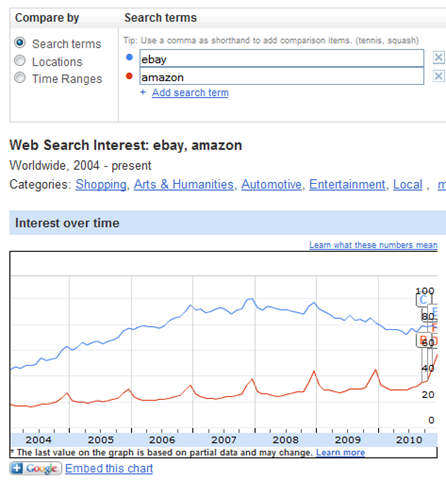
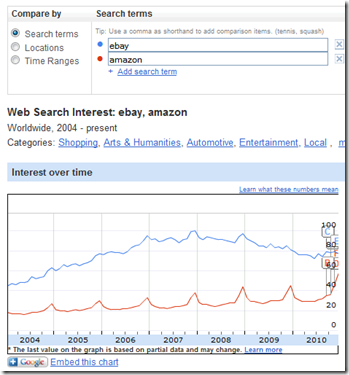
    I love what you can find in the Google Insights data:

    The blue line on the above graph was plumetting throughout 2009 but in 2010 eBay really seems to have stopped the rot and it’s great to see. This data (I believe) is a great guide to people’s intentions and interest and it just shows eBay is winning back attention (and of course the red line shows amazon’s growth and momentum just keeps on growing).

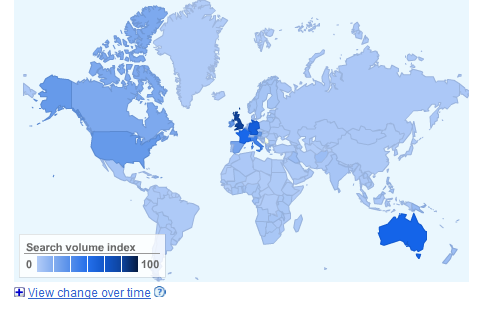
    Another interesting point that people miss is the geographic spread of eBay:

    Look at how powerful eBay really is in Europe. 3 years ago when I left eBay was #1 brand in Germany and was 45% of ecommerce in Italy. Come on eBay, you can grow back 🙂 just like this guy says:
  • Two nations seperated by a common language in search

    “Two nations divided by a common language” is a quote often attributed to George Bernard Shaw and I think it’s a pretty good one. In general going global for websites is pretty easy and I have been lucky enough to get lots of traffic for my websites from all the english language speakers around the world. That being said even with english language sites there are super interesting differences. I have spent my time on cocktailmaking.co.uk optimizing for the word cocktails and phrases like cocktail recipes (which I am lucky enough to own in the UK) and “vodka cocktail recipes” etc…

    In general I strongly believe that users from different countries are more similar that different. They all want great service, the web is better for all of them when experienced with their friends and a big red button will get anyone to click :). That being said you have to be careful about the details of how you approach things. When british people are looking for a cocktail they search for “cocktail recipes”, “vodka cocktail recipes”, etc… 5x more than “drink recipes” When Americans are doing the same they search for “drink recipes” 3x more than “cocktail recipes”. My british bias made me optimize for the wrong words on total volume.

  • Crowdsourcing rudeness ratings in cocktailmaking.co.uk

    One big issue I had last year is that I was thrown out of adsense for my cocktail site because of rude content. It turns out a lot of cocktails have rude names. As far as adsense is concerned “Sex On The Beach” is ok but some cocktail names are really not ok. That makes sense and I can understand advertisers not wanting to appear next to rude content. The issue for me is I have 10k user submitted cocktails and I am 5k behind in terms of reviewing and rating them.

    In order to solve this I defined all new cocktails as “rude” (rudenessid == 3 in my database) and then added a section at the top of each new cocktail asking users to review them. Then once a week I send myself a summary of the “unacceptable” and “rude” cocktails via email for me to go in and clean them up.

    The below gives an idea of how much data and how many reports are flooding in to help me fix this 🙂

    Users are super helpful and I have found overall that the crowd comes up with great accuracy each week. Especially when one of my facebook connected users review the content I can really trust user feedback on this front. I am still tuning the system but suddenly users are reviewing more cocktails each week than I have added AND the reviews concentrate in on the cocktails that are getting the most traffic. This really helps me keep the site clean in a crowd sourced manner. My friend Javi has an expression “work to not work” and this is a great example (in my opinion) of that!

  • This disgusts me or maybe it just makes me sad

    I am always looking for new ways to monetize my sites. I have 0.5MM users visiting monthly (give or take) but only make $10k’s a year. Not really a great ratio (according to my friends). As such I was interested to see what the following company was doing by buying adsense on my site.

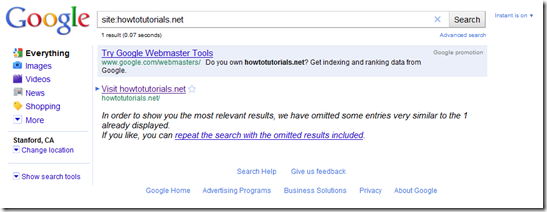
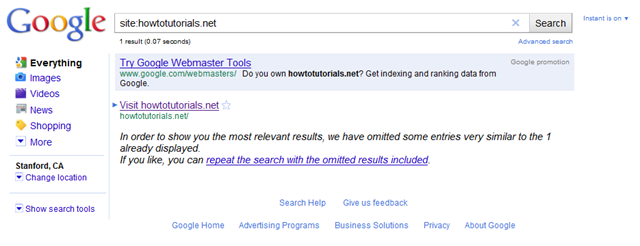
    For those of you who can’t see the text says “I accept the Terms & Conditions for $9.99/mo billed to my cell until I cancel for Access to How To Guides” and is clearly placed in a very hard to read font over an orange background. This sucks. They also do a really good job of retargeting you back to the article you were interested in if you close the browser and navigate to their homepage. The form too is super well optimized (in my opinion). Whoever does this is very good at what they do. Interestingly it seems the Google search index considers them spam, they are barely in it at all:

    I can totally see how (were I to do this on paper airplanes and cocktail recipes how I could get rich quick. There is no question I could game this to get a few % conversion and even if everyone cancelled after one month I’d make 10ks a month. I just feel it’s pretty immoral and now I am making money off this and my users are getting deceived through adsense. This isn’t adsense’s fault, how are they supposed to police this and even then it’s borderline whether this is illegal/in violation of their terms or not.

    Last year I deselected all deceptive ads from adsense and I recently ran the numbers on those. I think I cost myself $20k in the last 12months . That being said even with the following settings I couldn’t block the above ad:

    I have now made “howtotutorials.net” a blocked site for my ads and I don’t blame adsense at all. To be clear it’s the recurring billing and minimized terms I dislike. I think it’s ok to say “pay me XX through your cell to view your content”, that’s a pay wall and raising one of those is your decision as a webmaster. I just feel sad that so much of advertising on the internet is like this. We should be better. I need a new business model.

  • Great onsite merchandising by Google

    Google has done some really impressive onsite merchandising recently. Their product pages and search results layouts show a deep understanding of how to guide users toward conversion. The way they present information is clean, data-driven, and incredibly effective. It’s worth studying what they do because the principles apply to any website trying to optimize its user experience and conversion rates.

  • Creating country level heatmaps in Python

    I’ve been working on creating country-level heatmaps in Python for visualizing geographic data. This is really useful for showing things like user distribution, revenue by country, or any metric that varies by geography. I’ll walk through the libraries and approach I used. Python’s matplotlib combined with basemap makes this surprisingly accessible even if you’re not a mapping expert.

  • Facebook could eat the web – the Steve Rubel lifestream

    Steve Rubel from Edelman made an interesting prediction that Facebook could essentially eat the web. His argument is that as more content gets shared and consumed within Facebook, the traditional web becomes less important. While I think this is an overstatement, there’s definitely truth to the idea that Facebook is becoming the default way many people experience the internet. The lifestream concept – where all your online activity flows through a single platform – is becoming reality for many users.

  • Conan O’Brien gathers Facebook army for huge TV comeback

    Conan O’Brien’s use of Facebook to rally support after leaving NBC was masterful. He built an enormous Facebook following and used it to drive awareness for his new show. This is a great example of how social media can be used to build and mobilize an audience. The speed at which his Facebook page grew was remarkable and it translated into real viewership numbers for his TBS show.

  • Median vs Mean Part 2: CUME vs GRP in offline media and what it means for internet marketing

    This is part 2 of my series on median vs mean. In offline media, the concepts of CUME (cumulative audience) and GRP (gross rating points) are fundamental to understanding reach and frequency. These same concepts apply to internet marketing but are often misunderstood or ignored. Understanding the difference between reaching many people once vs. reaching fewer people many times is crucial for effective marketing strategy. The median user experience is very different from the mean, and this has huge implications for how you optimize your marketing spend.

  • Part 1: Median vs Mean – the key to understanding your website

    This is one of the most important concepts in web analytics that I think is misunderstood. When you look at averages for your website – average time on site, average page views, average revenue per user – you’re looking at the mean. But the median tells you what the typical user experience actually is. And these two numbers can be very, very different. Understanding this distinction is key to making good decisions about your website.