Blog

  • Mapping Every Time Team Dig: An AI Collaboration

    I’ve been a Time Team fan for as long as I can remember. There’s something deeply satisfying about watching Tony Robinson, Phil Harding and the gang rock up to a field somewhere in Somerset and spend three days finding Roman mosaics under someone’s back garden. The show ran for 20 series on Channel 4 from 1994 to 2014 and has been revived on YouTube since 2022 — that’s over 290 episodes and roughly 280 unique dig locations across 30 years.

    I’d always wanted a map of every dig site. The kind of thing where you’re driving through Gloucestershire and you can check your phone and go “oh, they dug a Roman villa half a mile from here.” So I decided to build one. But rather than spending weeks doing it manually, I did it with an AI assistant — specifically Claude, running as a persistent agent called Freddy Five that has access to tools, files, and the web.

    How we built it

    The process was genuinely interesting. I asked Freddy to find the location of every Time Team dig over the last 30 years. It started by pulling the Wikipedia episode list (which is surprisingly comprehensive) and then cross-referencing with individual series pages, the Time Team fan database, and the Time Team Digital YouTube channel. The Wikipedia data was particularly good because many of the individual series pages included actual GPS coordinates from the dig sites.

    The first pass produced 271 mapped locations with a CSV database, a KML file for Google Maps, and an interactive web-based map with Leaflet.js. Each location was colour-coded by era (Channel 4 in blue, specials in orange, YouTube revival in green) and you could search, filter, and click through to episode details. Pretty impressive for what was maybe 20 minutes of work.

    The critique

    Here’s where it gets interesting. I took the dataset and gave it to ChatGPT and asked it to critique the work. The feedback was thorough and honestly quite fair:

    1. A geocoding error — Aston Eyre in Shropshire had been placed at imprecise coordinates. Not in Italy as the critique suggested (it was actually still in Shropshire) but not as precise as it could be.

    2. Missing episodes — about 10 episodes had been missed, including some from Series 8, 12, 13, and 14 that weren’t on the main Wikipedia list page. Things like “The Leper Hospital” in Winchester, “Scotch Broch” at Applecross in the Scottish Highlands, and “The Abbey Habit” at Poulton in Cheshire.

    3. Coordinate precision — most coordinates were village-level centroids rather than actual dig site locations. Fair point for a research dataset, though for the purpose of “find nearby digs while driving” it’s more than adequate.

    4. No quality metadata — the dataset had no way to distinguish between a precisely known GPS coordinate and a rough village-level estimate.

    5. Naming inconsistency — titles were raw from Wikipedia rather than normalised to a consistent format.

    The fix

    So I fed ChatGPT’s critique back to Freddy and asked it to do a v5 quality pass. It fixed the Aston Eyre coordinates, added the 11 missing episodes (bringing the total to 291 rows), normalised all naming to a consistent pattern, added coordinate accuracy grades (A for site-level, B for village-level, C for broad centroid), and regenerated everything — the CSV, KML, and interactive map.

    The final dataset has 291 episodes, 281 mapped locations, coordinate accuracy grades, review flags, and a proper audit trail. One location — a 2025 Viking boat burial dig in Shetland — was deliberately left unmapped because no specific site coordinates have been published yet. I respect that kind of restraint in a dataset.

    The result

    Here’s the final map on Google My Maps — every Time Team dig from 1994 to 2025:

    View the Time Team Dig Locations Map

    Some things that jumped out once you see it all plotted:

    • Somerset is the most-dug county with about 16 sites. Makes sense — it’s basically one giant archaeological site.
    • London has around 14 digs, from Lambeth Palace to Vauxhall to Greenwich to Westminster Abbey.
    • They went international more than I’d remembered — Spain (twice), France (twice including D-Day), the Netherlands, Belgium, Nevis in the West Indies, and three trips to the USA.
    • The YouTube revival has been genuinely ambitious — Sutton Hoo, a Greek ancient city at Vlochos, and a Viking boat burial in Shetland.

    What I learned about working with AI

    The interesting bit isn’t really the map (though I’m quite pleased with it). It’s the workflow. The whole thing — research, data gathering, geocoding, map building, critique, quality pass — took a few hours of elapsed time and maybe 15 minutes of my actual attention. I asked a question, got a first cut, had another AI critique it, fed the critique back, and got a polished result.

    The most useful part was the critique step. Having ChatGPT audit Claude’s work (and vice versa) is genuinely powerful. They catch different things. It’s not unlike having two analysts review each other’s work — a practice I’ve advocated for years at Meta. The machines are getting good enough that peer review between them produces meaningfully better outputs.

    If you’re a Time Team fan, grab the map and use it next time you’re on a road trip. And if you’re interested in AI workflows, the key takeaway is: don’t treat AI outputs as final. Run them through a second model, or at least a second pass. The compounding quality improvement is real.

    Now if you’ll excuse me, I need to plan a Somerset road trip.

  • Making good on a (small) promise and hopes for 2015

    This year has been truly incredible for me. I hit 7years at Facebook, I helped the team get transgenders available on facebook, I was lucky enough to teach at startup school with an amazing list of other presenters, I got featured in the top 100 LGBT (I think British) business execs in the FT, made VP at Facebook and finally started to do something about charity work (very very limited) by teaching a few classes at Prince’s Trust for their young people. One promise I made as part of that last post was to link to anyone who asked me for a link. Only two people followed up. The first was Bhavin, his site is http://www.zenhypnosis.co.uk/. The second is http://www.bighair.co.uk/ from Melissa. Meeting Melissa in the valley on a tour with the trust inspired me to get involved in the group because I love their mission of helping young people help themselves. Too many times we try and solve things too late in the valley, we try and drive equality by getting folks way after they’ve been turned off from a career in tech. We need to fix things earlier. A big part of that I believe is allowing kids to see role models like themselves AND, importantly, role models unlike themselves. When I was a kid there were very few LGBT role models out there to look up to and none in business I was aware of. I hope that the OUTStanding team’s work on the top 100 list and that of Lord Browne with Glass Closet will help change that. Another group I feel are doing good work are http://www.diversityrolemodels.org/ who are trying to take LGBT role models into schools so kids see successful LGBT people, they believe when they do this it’s correlated with a decline in homophobic bullying.

    Either way a big hope for me in 2015 is to take all the luck I’ve had last year and convert it into something positive esp. focused on education, young people and LGBT folks feeling they have a chance to get to the top of any profession. Posting here will hopefully keep me honest on that.

  • Openness and, by extension, understanding

    The fundamental reason I am still at Facebook after 6years and for the foreseeable future is that I believe facebook has a big impact on the world and I can influence that impact (I am not a total saint, it’s not the only reason: I get paid well, have a great role, have a great team and colleagues, I’m learning a lot and it’s a sexy company to work at too but feeling connected to a bigger purpose does matter a lot to me). Specifically I believe that making the world more open and connected breeds tolerance and understanding. If you are connected to someone a little different than yourself, if they openly share that they are different and if you see what’s going on in their life day to day you simply cannot normalize hatred against that person or group of people. I believe facebook helps make that a little more true across nations, races, religions, sexualities and more. We have a great sub site: Peace on Facebook that shares some of this and always inspires me.

    On that front today was a pretty great day. Facebook launched support for transgender people to express themselves on the site. This is a project I’ve been involved with for a while and played a role in the background in getting it staffed, reviewed etc… at Facebook (there was a bigger team that drove it to launch with more impactful folks on that team than me for sure).

    One part of this is I typically hate doing press and have avoided it but as I have been promoted it’s been harder and harder to avoid it and I’ve had to practice more and do more. The press around this has been the biggest I’ve ever been involved with and my first broadcast interview (with the AP). The following picture is a screen shot of a TV in Moscow that a travelling friend shared with me and it’s amazing to see the story has gone around the world even to places with low tolerance for LGBT rights like Russia. That makes me feel really glad I got out of my comfort zone and did the press (thanks to a friend called Slater who pushed me to do it).

    Down the years at Facebook I’ve been lucky enough to have the opportunity to take part in our it gets better video. I can really see how (as a young nerd) I would have sought out this video had it existed and watched it and it would have made me feel better and less alone. I also got to be involved in getting same sex marriage launched on the site globally and more over time.

    I guess the bottom line of what I want to say is: it’s great to be part of a really tolerant and accepting company that wants to create a product where everyone can express their authentic self, build a more open and connected world and hopefully, by extension, a more tolerant and understanding one. We are, of course, not perfect and (in the words of Benjamin Zander in his amazing TED video I HIGHLY recommend watching this, gets me every time) we’d make ourselves wrong by holding ourselves to a standard of perfection but it is a possibility to live into and I am so lucky to be part of this journey and this amazing company & launch. I hope you all can be inspired to take the time to do things like this where the opportunities exist in your jobs (because I am sure they do). 🙂

  • Context matters when thinking about mobile growth

    I have written here plenty of times about my cocktail making and paper airplanes sites. I have also written in the past about the depressing truth of shrinking markets and about finally getting to the year of mobile in 2010. This is really important when I look at the growth of both of my websites.

    Specifically the mobile internet is growing really, really fast but the desktop internet is slowing down and usage is transitioning to mobile. The interesting thing is that different topics lend themselves to mobile and to the web today. Paper airplanes and cocktail recipes make a really nice pair of examples for that:

    When you look at paperairplanes.co.uk the mobile web is still a very small percentage (you probably want to sit at a computer screen/desk making these):

    Whereas with cocktailmaking.co.uk the mobile web is already at 50% (you are probably in a bar or at a friend’s house and trying to figure out what to drink/how to make your favorite drink):

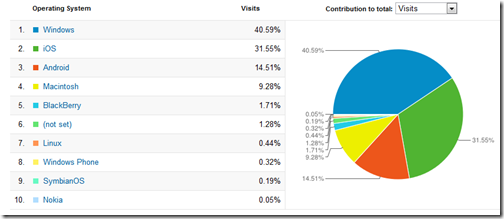
    The same holds true when you think about what mobile OS you are optimizing for. In India it seems you’d be an idiot to spend a minute thinking about iOS whereas in the USA you’d be crazy not to have iOS as a top priority. Mobile is the future, it’s on a clear track to be the majority of all traffic to my websites but I should be focusing on mobile for cocktails whereas maybe, long term, paper airplanes is a dying business (perhaps I could fight off the increasing number of competitors in web SEO but I am not sure it’s worth it).

  • Making a little effort on improving my cocktailmaking.co.uk facebook integration

    A little bit of time investment can really pay dividends. Up until last weekend my cocktail site has been running off of the old php connect sdk. One of my little projects for Christmas was to see if I could migrate everything to the new Facebook Platform. It was shockingly easy to get everything done. The Facebook Javascript SDK is really easy to use and there is a great example of how to get the data back and forth from Facebook.

    I work for Facebook but am no means a developer or working on the platform team. It’s just great to see how big a change the platform improvements from earlier this year have made to my integration (now I finally found time to implement them).

  • Big impact from reducing page weight and load times

    Another holiday project for me was to work on reducing the load time for my pages. There were a few reasons for this:

    1. I was using bandwidth like it was going out of fashion and finally was about to violate my (very generous) limits
    2. My pages were taking a ridiculous time to load and it was just embarrassing
    3. Google have very publically been stating that page speed is important for ranking (and the whole web has focussed on this in 2010)

    As such I used my webalizer log file analytics package to pull out the highest bandwidth files and I isolated that the moo tools js (I was using for some super simple text animation) and a promotion banner were using 40% of the bandwidth. Although this is stating the obvious usually 90% of the actual impact of the problem you are dealing with is driven by 10% of the problems. Webalizer is a great way (on bandwidth usage) of homing in on the causes. I did about 2hrs of work to hack everything around and reduced my bandwidth usage by 25%. The surprise for me was that I saw an immediate impact on my data:

    All year my pages per visitor has been down substantially. Users were getting bored and leaving the site faster. Reducing the page weight by 40% increased my page views per visitor by 25%. What was really interesting about this is that it stood out in all my data. For example even though I should have cut total bandwidth usage by 40% it only went down 25% since the number of pages being downloaded from the site spiked substantially. This was awesome to see 🙂

  • 2010 really was (finally) the year of mobile

    A few high level stats that really show how much mobile has shaped 2010 for my websites. The following data is from one of the automated reports I run using the google analytics api. Firstly here is the weekly visits by OS, # growth year on year and % growth year on year.

    As you can see iPhone has grown at >200% and android at almost 1000%. What is really interesting is that together they equate to 15% of the total windows desktop visits in that same period. Even though my cocktail site is not designed for mobile, it is now, rapidly, becoming a mobile site. One other interesting point to notice is how large the iPad already is, 1/3 of android from absolutely nowhere.

    A second interesting data set is screen resolution:

    Once again the super interesting data point is that teeney tiny screens (e.g. 320×480) are growing at 1000%s year on year whereas the classic desktop resolutions are growing far slower.

    I am seeing this across both paperairplanes.co.uk and cocktailmaking.co.uk. It is super interesting to see that all the predictions of the year of mobile coming have finally come true. It’s supported in the data not just the hype on the street.

  • The traffic impact of Facebook social plugins on my cocktail site

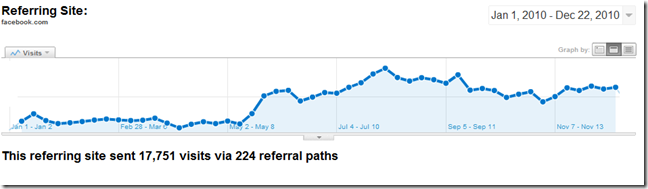
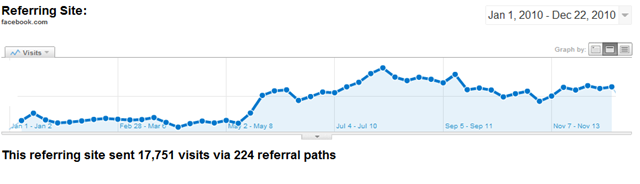
    The above shows referred traffic from facebook to my cocktail site. It is pretty clear where I installed the social plugins, most specifically the comment box. Facebook is now my #1 non search engine traffic referrer and is very close to bing and yahoo (which are about equal) as sources of traffic. By the middle of next year I expect facebook to be the #2 referrer of traffic to my site which is super exciting considering I have not optimized the integration for traffic at all yet 🙂

    Below is a great example of a discussion thread on a the flaming lamborghini cocktail recipe on my site 🙂

  • Changing search behavior and the depressing truth of a shrinking market

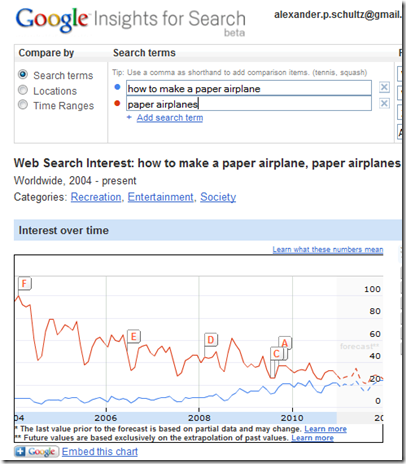
    This image is interesting to me. Firstly it shows that paper airplanes (for whatever reason) are getting less and less interesting to people over time as a proportion of what is being searched for online (the red line). I think there are a lot of reasons for this but in the end kids are getting more and more into computers. Analog entertainment like paper airplanes are just not as cool as angry birds.

    The second trend that is interesting to me is the only growth keyword (amongst the major paper airplanes keywords) is “how to make a paper airplane”. This definitely fits with the general refinement trends I am seeing across all of my sites and work. Queries are getting more complex and specific.

    Also it’s irritating that this is a query I lost a few years ago and still haven’t won back 🙂

  • Search data backs up eBay starting to stop the rot

    I love what you can find in the Google Insights data:

    The blue line on the above graph was plumetting throughout 2009 but in 2010 eBay really seems to have stopped the rot and it’s great to see. This data (I believe) is a great guide to people’s intentions and interest and it just shows eBay is winning back attention (and of course the red line shows amazon’s growth and momentum just keeps on growing).

    Another interesting point that people miss is the geographic spread of eBay:

    Look at how powerful eBay really is in Europe. 3 years ago when I left eBay was #1 brand in Germany and was 45% of ecommerce in Italy. Come on eBay, you can grow back 🙂 just like this guy says: